
Checking for a Warrant in Secretary
A Secretary warrant check begins beyond the town line, since every office that keeps the records sits in Cambridge. Work the steps in order. Stop when the office that owns the case answers.
- Search Maryland CaseSearch by name or citation number.
- Call the District Court clerk at 410-901-1420 for a traffic, misdemeanor, or ordinance case.
- Call the Circuit Clerk at 410-228-0481 for a felony or serious criminal file.
- Call the sheriff at 410-228-4141 to learn which agency holds the warrant for service.
- Ask Town Hall only which office issued a town notice, never for warrant status.
A call to a town office fills in for none of these steps, and no single clean result closes the matter.
Secretary Warrant Records by the Numbers
Secretary ranks third among the county's incorporated places by population. That size is why the town has no police department or court counter.
The zero is the number that matters. With no town force, deputies from the sheriff's office or another agency serve the papers, and the case stays with the county court from start to end. Note: Official sources publish no current warrant count for Secretary, so the figures above cover population and charter context only.
Secretary Police and Municipal Court
Secretary fields no police department and no municipal court of its own. Maryland's official court directory shows only the Circuit Court, the District Court, and the Orphans' Court for the county, and the town holds no role in any of them. That leaves the county system as the single route. A traffic or ordinance citation tied to a Secretary address turns into a District Court case, while a serious criminal charge heads to the Circuit Court. Need an officer? Residents call the sheriff's office, because no town department exists to dispatch.
Secretary Town Hall and Warrant Questions
Town Hall is still worth a call for what it does. It handles town business, not warrants.
The Maryland Manual Secretary entry names the town clerk and treasurer, the town attorney, and water and wastewater contacts, with no police or court line in the list.
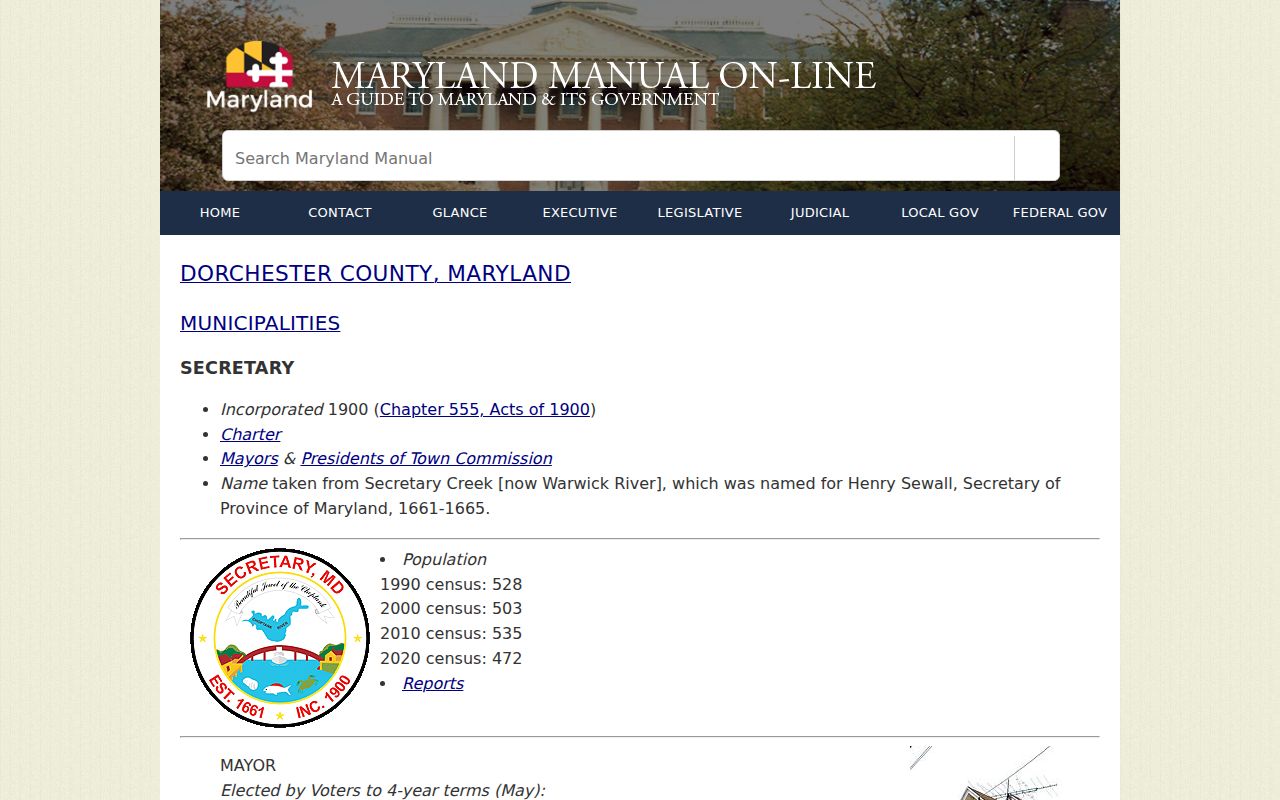
Read it for town contacts, then take anything about a court case to Cambridge.
Where Secretary Warrant Questions Go
The two titles sound alike yet answer wholly different questions, so picking the right one saves a day.
| Office | Where | What It Can Tell You |
|---|---|---|
| Secretary Town Clerk | 122 Main Street | Town services, permits, code notices, water accounts |
| District Court clerk | 310 Gay Street, Cambridge | Traffic, misdemeanor, and ordinance case status |
| Circuit Clerk | 206 High Street, Cambridge | Felony and serious criminal case status |
| Sheriff's Office | 829 Fieldcrest Road, Cambridge | Service assignment and booking coordination |
A water bill belongs to the town office in Secretary, and a warrant question belongs to the court. Neither desk can handle the other's paperwork. Go to the office that actually holds the record you need. Note: Only the docket entry counts, so ask the clerk to read it aloud instead of trusting a summary.
Secretary Warrant Types
Several kinds of court process can carry a Secretary address. Each type of warrant points to a different office.
| Warrant Type | How It Arises | Who Issues It |
|---|---|---|
| Traffic failure-to-appear warrant | A missed traffic date or an unanswered citation | District Court judge |
| Bench warrant | A missed court date or a release violation | The judge on the case |
| Arrest warrant | A charging document plus probable cause | Commissioner or judge |
| State capias | Circuit Court arrest process | Circuit Court judge |
| Body attachment | Contempt or family-support enforcement | The court that issued the order |
Secretary Traffic Warrants at District Court
A traffic citation written in Secretary goes to District Court no matter where the driver lives. The citation itself sets the clock for acting on it.
- Respond within the window printed on the citation, choosing payment, a payment plan, a guilty plea with explanation, or a trial.
- Ask the clerk about a payment plan if the total is large, since Maryland offers installment plans for qualifying traffic fines.
- If a court date was missed, write to the court that set it and request a new hearing date.
- Ask separately whether the missed date also produced a warrant, because payment and warrant status are different questions.
Caution: A missed date can trigger both a license notice from the Motor Vehicle Administration and a court warrant. Clearing one does not clear the other.
The traffic warrant search page explains how the court side is cleared.
Inside a Secretary Warrant Record
A warrant record tied to a Secretary case looks like any other Dorchester County court file. The town name simply shows up as the place of the offense.
| Case or Citation Number | The first identifier the clerk asks for (case number as filed) |
|---|---|
| Agency | The sheriff or another agency named on the paper |
| Charge or Court Order | The offense or obligation the person did not meet |
| Issuing Court | The District Court or Circuit Court in Cambridge |
| Bond or Release Status | Whether an amount is set or a judge must decide |
| Status | Active, served, recalled, quashed, or returned |
Ask the clerk to read the docket entry aloud rather than describing it secondhand.
Secretary's 1900 Charter and Warrant Routing
Secretary incorporated in 1900, and the Maryland Manual traces the town's name to Secretary Creek, now the Warwick River. That waterway took its name from Henry Sewall, Secretary of the Province of Maryland from 1661 to 1665. The town's official site posts the current municipal contact block for anyone who needs to reach the town office.

The history is pleasant, but it also works as a routing clue. Town records are municipal records, and a court warrant is not one of them.
How Secretary Warrants Fit the County System
Warrant flow: Secretary citation or charge › District Court or Circuit Court in Cambridge › clerk docket entry › sheriff service and return.
Dorchester County's courthouses, commissioner station, and detention center all sit in Cambridge. A Secretary resident with a court matter makes the same trip a Cambridge resident would. The full county picture, including the after-hours commissioner route, is laid out on the county warrant records home page.
Secretary Ordinance Notices and Court Warrants
A town ordinance question in Secretary usually starts with a notice in the mail. The fastest way through it is learning who issued the paper and where it was filed.
- Ask the town clerk which office sent the notice and what it concerns.
- Ask whether the matter was filed with a court, and if so, which one.
- Ask for the citation or docket number if one exists.
- Keep the notice and any envelope, since the date on it may matter later.
A Secretary code notice and a court warrant are different things. The town employee who wrote the notice has no power to undo a judge's order. Once a court date shows up on the paper, the matter belongs to the court alone. Note: town staff can explain a notice, but only the court can confirm how a case stands.
Secretary Warrant Records and Public Access
Maryland court records are open to inspection in general, but the public never sees every warrant document. CaseSearch displays selected Circuit and District Court material, and the clerk can open the underlying file for you. The inspection rule comes from General Provisions §4-201, while Maryland Rule 16-914 bars release of certain arrest-warrant records and search-warrant material before execution. Juvenile, sealed, shielded, and expunged files stay closed too. For a Secretary warrant question, that means the court file is the place to ask. Records the sheriff keeps rather than the court can still be requested in writing under the Maryland Public Information Act. Send that request to whichever office actually holds the file.